
| STORY CREDITS Interviewer and Writer: Apeksha Srivastava Photo: Arijit Reeves and Megh Modi |
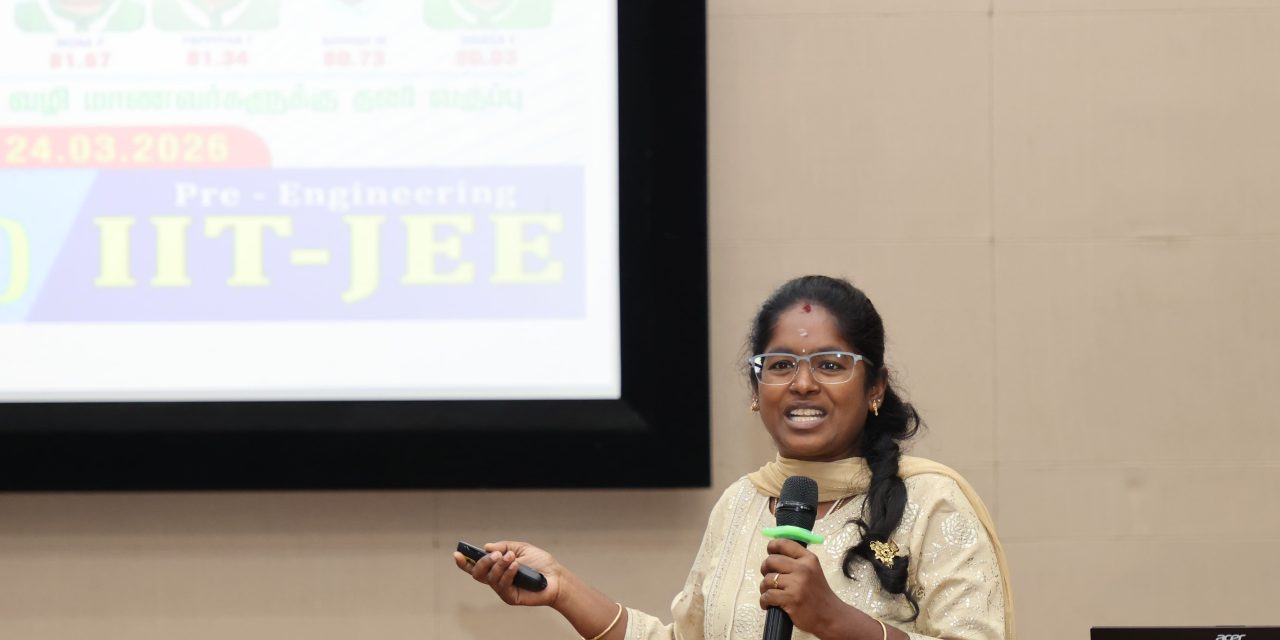
My interaction with Dr Gayathri during Women Force 2026, organised at IIT Gandhinagar, provides a glimpse into her journey from being a researcher to becoming a mentor. Today, she guides hundreds of children from rural Tamil Nadu, serving as a catalyst for first-generation underprivileged students. By providing the opportunities and guidance necessary to enter premier institutions, she is transforming the future of countless families.
Please tell us something about yourself.
My name is Dr Gayathri Purushothaman. Currently, I run a coaching institute that prepares students for competitive examinations such as the National Eligibility cum Entrance Test (NEET), IIT-Joint Entrance Examination (JEE), and Common Law Admission Test (CLAT), along with other central entrance exams. I completed my undergraduate degree at Tamil Nadu Agricultural University, followed by my master’s degree at IIT Kharagpur. After that, I started my PhD at IIT Gandhinagar. During my PhD, our research group published several research papers and secured two patents based on our work. My research was interdisciplinary, combining chemistry, biology, and biochemistry. During this time, I received one of the most prestigious recognitions, the Young Scientist Award, to attend the Lindau Nobel Laureate Meeting, at which young scientists get the opportunity to interact with Nobel Laureates directly. In this meeting, I even received an opportunity for a postdoctoral position at Humboldt University in Germany. I also received grants, such as the Council of Scientific & Industrial Research (CSIR) travel grant, which provides financial assistance to young Indian researchers, to attend international conferences. I have been the recipient of several poster awards.
After completing my PhD, I had to decide what to do next. Naturally, postdoctoral research was one of my options. However, when I returned to my hometown, which is a rural area, I realised something important. Many students there were intelligent and capable, but they lacked proper guidance and awareness about what to do next or how to prepare for competitive exams. Since I also come from a rural background, I understand how difficult that journey can be. Even my own path was not easy. After my higher secondary education, I discovered Tamil Nadu Agricultural University only through a newspaper. Similarly, I first learned about the Graduate Aptitude Test in Engineering (GATE) and other national entrance examinations during my undergraduate years. Because I experienced the struggles of moving forward without guidance, I felt that I should transfer my experience to students who truly need it. So, along with my husband, Mr Sriram, we started a coaching institute called C Academy in Thanjavur. Our focus is primarily on students from rural areas and government schools.
How would you describe your research to a non-technical audience?
During my PhD, I worked on a bacterium called Helicobacter pylori, a major cause of stomach ulcers. It can sometimes lead to stomach cancer. Just as humans need proteins to survive, bacteria also rely on specific proteins. Our research focused on targeting a critical protein in this bacterium. If we can block that protein from functioning, the bacterium cannot grow in the stomach. In simple terms, my research involved identifying and targeting a protein in the bacteria so that it cannot survive, which could eventually help prevent ulcers.
When did you start C Academy? Please tell us something more about it.
So, we started the academy around 2019–2020. Our main goal was to train students for NEET-UG and IIT-JEE examinations. Over the last five to six years, nearly 200 students from our academy have scored good marks in NEET and are now studying in various government medical colleges. Most importantly, many of these students come from government school backgrounds, where they are often unaware that if they secure admission to government medical colleges, they may not need to pay tuition fees for their entire Bachelor of Medicine, Bachelor of Surgery (MBBS) degree. Similarly, more than 100 students from our academy have cleared JEE Mains. They are now studying in prestigious institutions such as Indian Institutes of Technology (IITs), National Institutes of Technology (NITs), and Indian Institutes of Information Technology (IIITs). Therefore, we not only train students academically but also create awareness about scholarships and entrance exams. We regularly visit government schools and conduct awareness programs about higher education opportunities.
Currently, we have a residential campus, where more than 300 students are receiving coaching. I would also like to mention that in January 2026, during the JEE Mains examination, about 70 students from our academy scored above 80%. Many of them are from rural backgrounds and have studied in regional language mediums and not English. Despite these challenges, they successfully cleared the exam and became eligible for admission to premier institutions. We are extremely proud of this achievement.
What does it mean to be a woman in STEM for you?
My vision goes beyond being a scientist. I want to ensure that STEM education reaches everyone equally, especially women and children from rural backgrounds. Right now, opportunities exist, but many people are not aware of them. Our goal is to build a bridge between opportunities and the students who need them most, regardless of their economic or social background.
What have been some defining moments in your career, research and beyond?
I love research and working in the lab. During my PhD, even a small result, such as successfully running a Polymerase Chain Reaction (PCR) experiment, gave me immense confidence and excitement. In simple words, a PCR rapidly produces millions of copies of a specific DNA segment to be studied in detail. Those small milestones made me feel that I was contributing something meaningful. Meeting Nobel Laureates during the Lindau meeting was also extremely inspiring and a defining moment in my life. However, today my biggest motivation comes from seeing my students succeed. For example, one of our students from a poor rural family scored 13th rank at the state level in the NEET exam and secured admission to Madras Medical College. When I visited her house, it was a small mud house, and she was the first educated person in her family. Seeing her become a doctor meant that the entire direction of that family’s future would change in a positive manner. Most of my students are the first generation to be educated in their families. Moments like these make me incredibly proud and motivated.
What challenges did you face to reach where you are now?
We have to work more, find more people and spread more awareness. One of the biggest challenges is convincing parents, especially when it comes to educating girls. Many parents believe that once their daughter finishes 12th grade, she should get married. Convincing them to let their daughters pursue more years of education is extremely difficult. Sometimes, I spend hours talking with parents, explaining opportunities and showing them previous results to build trust. In many cases, I tell them: “Your daughter will be like my own daughter, and I will take responsibility for her future.” Only after building a certain level of trust do they agree to let their girls study further.
Another incident that I would like to share involves one of our students, who cleared JEE Mains and secured admission to an NIT. Her parents refused to send her. They believed they could not afford the expenses. This was during the COVID pandemic in 2021, when visiting campuses was difficult. So, my husband and I paid the fees ourselves to secure her seat. We supported her financially for the first year, and she continued her studies. Eventually, her parents understood the value of the opportunity. Today, she has completed her degree, and her family’s situation has improved for the better.
What advice would you want to give to school girls?
Explore all opportunities! Believe in yourself. In my area, I was the one who went to school using a bus. I was the first one to pursue my senior secondary education in an urban area, to pursue my bachelor’s degree outside the town, and to cross the state border to pursue my master’s degree. Now, I want to set a path for others. Girls should be brave and confident. Most importantly, they should love what they do. Enjoying your work inspires you to overcome any challenges along the way.
How do collaborations shape your work?
Right now, my focus is on preparing the next generation of researchers, doctors, and engineers. My aim is to ensure that students from rural backgrounds gain access to premier institutions. We want to make these opportunities open to anyone with talent and determination, regardless of where they come from. Hence, the most valuable collaboration would be with government schools and educational authorities. If we receive support to extensively conduct awareness programs and training programs in rural schools, it will help us reach many more students.
Another point with respect to collaboration is that my husband and I are doing this work together. I think that if I had a motivating person like him during my childhood, my journey would have been easier. So, I feel very proud of him. Our student, whom we saw in the school uniform, is now in a white coat and stethoscope and puts doctor before her name. Another student who went to NIT has now completed his degree and got placed in a really nice company. So, these incidents motivate us to work further in this direction.
Why do you think events like ‘Women Force’ are important for India?
Programs that highlight successful women’s journeys are extremely important. When women share their experiences, it gives other women the confidence to tackle problems and overcome them. It is about truly realising what women can achieve. I believe that such initiatives should also reach school-level students, so that young girls can understand their potential and opportunities early in life.
What message would you like to send out to young women aspiring to join the STEM fields?
Science is not difficult. It is actually part of everyday life. See, for example, biology explains how our body works, physics explains everyday actions and movements, and chemistry explains the reactions happening around us. Young women should understand what they are studying rather than fear it. Being a woman often means balancing both personal and professional responsibilities, but that should not stop anyone from pursuing their goals. We should be clear about what we want to do and be consistently dedicated towards achieving our goal.