| STORY CREDITS Interviewer and Writer: Apeksha Srivastava Photo: Arijit Reeves and Megh Modi |
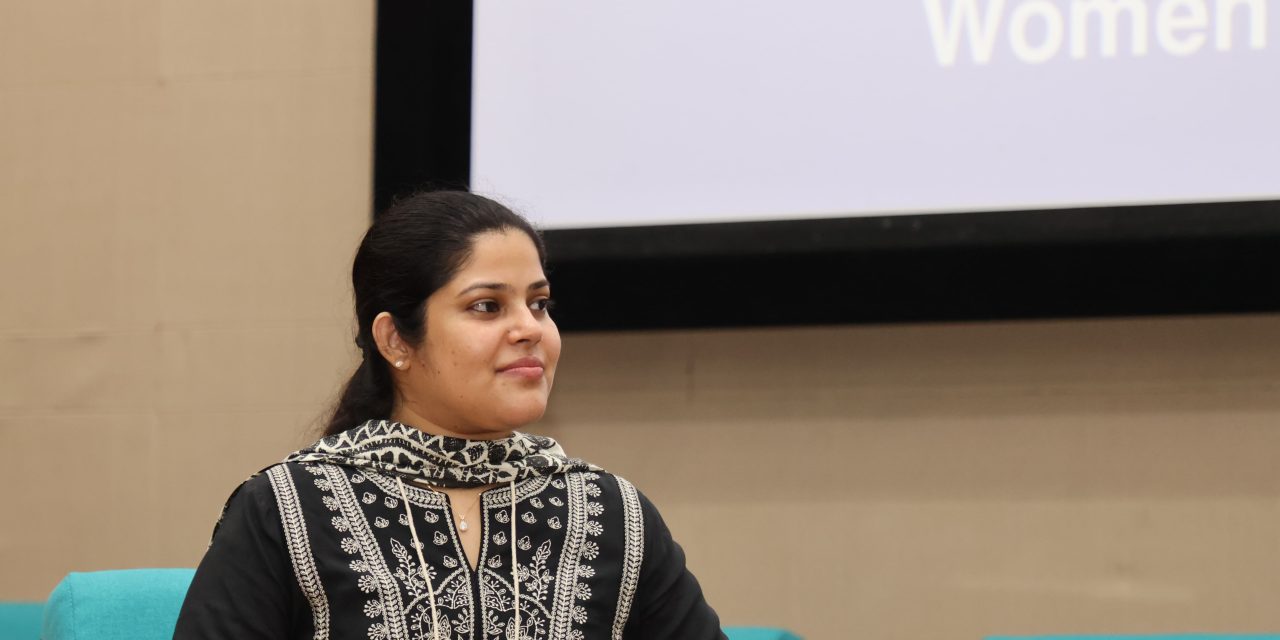
Next up, I interviewed Dr Asha during Women Force 2026, organised at IIT Gandhinagar recently. The following paragraphs provide a glimpse into her journey, from a curious school student to a researcher and later an Associate Publisher at a scholarly publishing platform. Her experiences mirror the true essence of the first edition of this conclave.
Please tell us something about yourself.
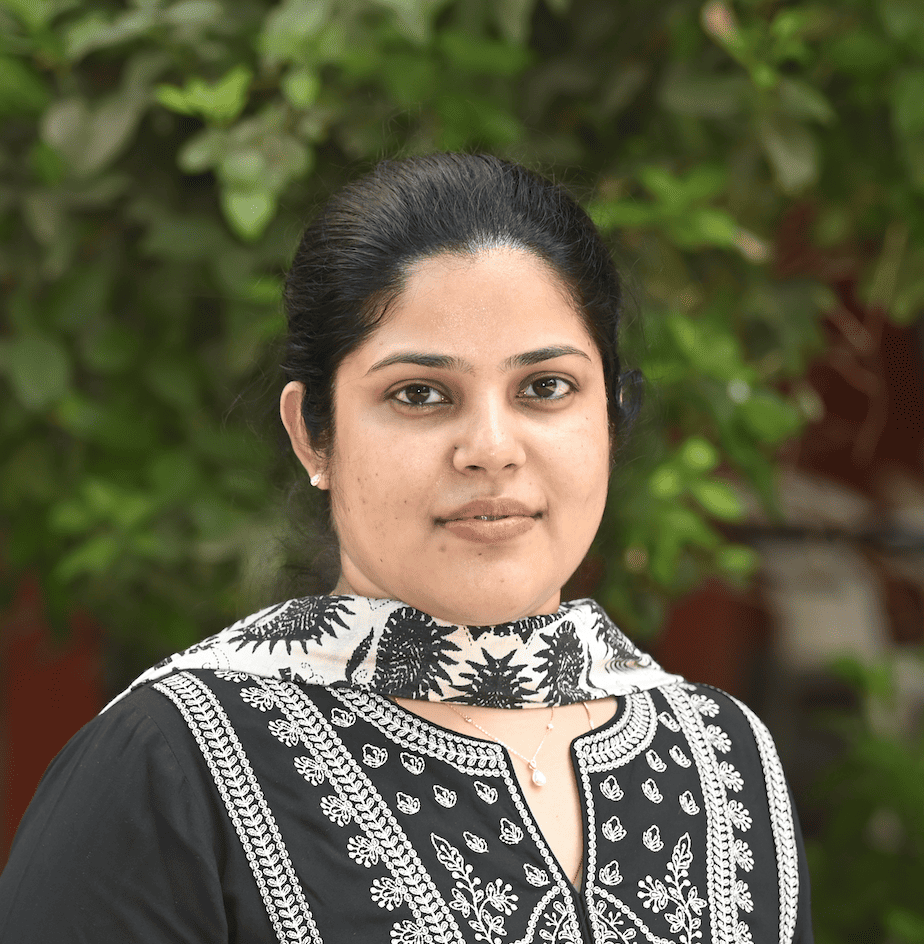
I am Asha Liza James, a proud alumna of IIT Gandhinagar. I grew up in Kerala, where I completed my schooling and earned my BTech in Biotechnology and Biochemical Engineering before moving to IIT Gandhinagar for my PhD. I worked in the Chemical Engineering department with Professor Kabeer Jasuja, focusing on materials chemistry and nanoscience, an experience that shaped my interdisciplinary outlook.
While I loved research, I was equally drawn to reading, writing, and communicating science. That interest ultimately led me to pursue a career beyond academia and into scientific publishing. Today, I serve as an Associate Publisher with ACS Publications, a highly reputable and trusted publisher in chemistry and related sciences, providing a high-impact portfolio of 90+ peer-reviewed journals, eBooks, and scientific content. I am part of its Global Editorial Strategy team and collaborate closely with journal editors from around the world.
Outside of work, I am an absolute homebody at heart. I enjoy reading, cooking, and noticing the small, beautiful details in everyday life; quiet moments that bring me joy and help keep me grounded.
What does it mean to be a woman in STEM now?
To me, being a woman in STEM today means being represented, included, and truly heard. It means having our contributions recognised and our voices amplified. Over the last few years, I have seen meaningful progress: more supportive environments, more initiatives, and more encouragement from colleagues, families, and society at large.
When I was a student attending conferences, I remember seeing a few women in the audience and even fewer on the stage. Today, I am heartened to see far more women presenting their science with confidence. In my current role, it is inspiring to work alongside so many wonderful women, both in the office and across virtual meeting rooms. Workplaces are becoming more inclusive with flexible hours and childcare support, and that shift matters.
Of course, there is still much more to be done. I hope even more women find strength and sisterhood in science, supporting, uplifting, and nurturing one another as we continue to shape the future of STEM together.
What has been one defining moment in your career that strengthened your path in science?
For me, it has not been one defining moment, but a collection of experiences that quietly shaped my path in science. It began with my mother’s own scientific journey. Despite every challenge thrown her way, which included raising two chaotic children, managing a full‑time job, and pursuing a PhD in polymer chemistry, she never wavered. As a child, I would accompany her to the lab and watch her run experiments. She used to educate me on the importance of proper referencing and the harms of plagiarism while helping me with my school assignments and reports. Without realising it, I was absorbing a deep respect for curiosity, ethics, and the scientific process.
Another pivotal moment came in 11th grade, when I was selected for the Council of Scientific & Industrial Research (CSIR) Youth for Leadership in Science program at the CSIR‑National Institute for Interdisciplinary Science and Technology, Thiruvananthapuram. Those two days of lectures, quizzes, and lab visits, including seeing a transmission electron microscope for the first time, left me completely invigorated.
What advice would you want to give to school girls who are visiting IITGN on Science Day?
My advice would be: ask lots of questions and stay endlessly curious. Value in‑person interactions because real conversations often give you clarity that the internet cannot. In a time when AI and online information can be biased or misleading, seek out mentors, teachers, and role models who can guide you in the right direction. Surround yourself with people who encourage your curiosity and believe in your potential.
How would you describe your field to a non-technical audience?
I work with ACS Publications, which is part of the American Chemical Society, and it is one of the world’s most trusted sources of scientific information. Think of it like a global library where scientists publish their discoveries so others can learn from them, build on them, and solve real‑world problems. We publish high‑quality journals, magazines, books, and digital resources that help researchers, students, and industries stay updated on the latest advancements in chemistry, medicine, environment, materials, and related fields.
What emerging area in your discipline excites you the most?
Artificial intelligence is both an exciting and slightly intimidating development in our field. It is transforming the way we conduct research and communicate scientific ideas. AI can sharpen language, make writing more concise, and streamline many aspects of scholarly communication. While it is a powerful tool, it should remain just that: a tool. Science must still be driven by human curiosity, creativity, and critical thinking. AI can support the process, not replace it. I know its rapid adoption worries many, but I believe it is here to stay. Our responsibility is to use it thoughtfully, ethically, and with a clear understanding of its limitations.
What has been your most fun research and work experience?
One of my most fun research experiences was spending two months as a visiting scholar at the Japan Advanced Institute of Science and Technology during my doctoral studies. On a personal level, it felt surreal as I grew up watching anime and admiring Japanese culture; so experiencing it firsthand was incredibly special. Scientifically, it was eye‑opening to work in a completely different ecosystem, surrounded by high‑end instruments, world‑class research, and a unique work culture. And yes, plenty of ramen and mochi kept the foodie in me very happy!
In my current publishing role, a standout experience has been collaborating with global colleagues to develop a Diversity, Equity, Inclusion, and Respect (DEI&R) training course for journal editors. It was deeply fulfilling to help sensitise editors to the realities of modern science: how biases can unintentionally creep in, and how diversity in geography, gender, career stage, affiliation, and research topics strengthens the scientific community. I loved the multicultural, collaborative environment as part of the course development team and the opportunity to contribute to a more inclusive and equitable publishing ecosystem.
Have there been any cross-disciplinary inspirations in your work?
When I began my PhD, I was working on nanoscaling a material called magnesium diboride to obtain boron-based nanosheets. It was suddenly all chemistry and materials science, and it felt far removed from my biotechnology background. One day, out of homesickness for something bio-related, I was flipping through the pages of Lehninger Principles of Biochemistry. I was suddenly reminded about using some chemical reagents for trapping magnesium ions in DNA extraction protocols. That familiar concept sparked the idea that I could apply a similar approach to trap magnesium ions and isolate boron-based nanosheets from my material, magnesium diboride. So while my research was chemistry‑focused, the insight came directly from my training as a biotechnologist. My doctoral committee consisted of members coming from chemical engineering, biology, and chemistry departments; they reinforced this interdisciplinary spirit by asking questions that challenged my assumptions. These experiences showed me that science is really one interconnected story, and the most interesting ideas often emerge at the intersections.
How do collaborations shape your work?
Collaborations shape my work in every possible way. Being part of the Global Editorial Strategy group at ACS Publications means working across diverse teams, time zones, and geographies, all connected by a shared commitment to science. When we keep that common purpose at the centre, collaboration becomes far more meaningful and fluid. Understanding each other’s perspectives and maintaining transparent communication are essential; it makes teamwork not just productive, but genuinely enriching.
In your field of work, what is something that still continues to surprise you?
One thing that still surprises me is how easily ethical considerations in research and publishing are sometimes set aside for short‑term benefits. It highlights the need for stronger awareness, mentoring, and systems that prioritise integrity above speed.
What advice would you want to give to someone who wants to start their professional journey in research or publishing?
My advice would be to start with clarity: understand what you enjoy, what your strengths are, and just as importantly, what you do not want to do. Playing to your strengths will help you thrive, but being aware of your limitations can be equally valuable when you are choosing between different career paths. Both research and publishing offer many possibilities, so stay open, stay curious, and do not be afraid to explore opportunities that align with your interests and values.
What is the one lesson you wish that more young researchers understood early?
There is a saying I love: “Fall seven times, stand up eight.” Science isn’t built on perfect experiments; it is built on persistence, curiosity, and learning from what doesn’t work. I wish more young researchers understood early that failure is not a setback; it is part of the scientific process and often where the real learning happens. Do not be afraid of mistakes; you can always bounce back stronger. And above all, remember that your physical and mental well‑being matter just as much as your research.
What misconceptions do researchers have about the peer review or publishing process?
That’s a great question! As a PhD student, I used to feel that editors and reviewers were working against us, that they were on the enemy side. But after moving to the other side of the process, I have realised that this is far from the truth. In my six years of working closely with editors, I have seen that almost everyone is genuinely trying to help authors improve their work.
Peer review isn’t perfect; we all acknowledge that. But despite its limitations, most reviewers offer thoughtful advice, constructive feedback, and important ethical guidance.
It is also essential for researchers to remember that responses to editors/reviewers should remain professional; you can always disagree respectfully and clearly explain why a particular suggestion may not be feasible.
How can India strengthen its culture of responsible and impactful scientific communication?
India can strengthen its culture of responsible and impactful scientific communication by investing in formal training on research ethics, integrity, and communication skills from early career stages. While science and technology in India are flourishing, awareness of science communication as a discipline is still limited. We need long‑term national frameworks, not just short‑term initiatives, to build trust, transparency, and public engagement. Thoughtful use of digital tools and social media can further amplify credible science and bring it closer to society.
What message would you like to send out to young women aspiring to join the STEM fields?
Learn to prioritise yourself and trust your own journey. Love what you do, and let that passion guide you. Never hesitate to ask for help: seeking support from peers, mentors, or teachers is a sign of strength, not weakness. Surround yourself with people who uplift you, believe in your potential, and remind you that you belong in these spaces just as much as anyone else!
Why do you think events like Women Force are important for India’s research ecosystem?
Events like Women Force are essential for strengthening India’s research ecosystem because they create a dedicated space for women – whether students, early‑career scientists, or senior faculty/researchers – to connect, relate, and learn from one another. They spark conversations that go beyond day‑to‑day work, encouraging participants to think deeply, ask new questions, and build meaningful professional and personal networks. These platforms also make room for honest discussions, from funding challenges to research hurdles to personal experiences. Most importantly, events like Women Force plant the seeds for a strong sisterhood in science, empowering women to uplift and inspire one another.