| STORY CREDITS Writer: Niriksha Kansara Photo: IITGN Photos |
A five-day cultural festival bringing together legendary artists, immersive workshops, and classical performances, welcoming both the campus community and the wider public to celebrate India’s rich artistic heritage.
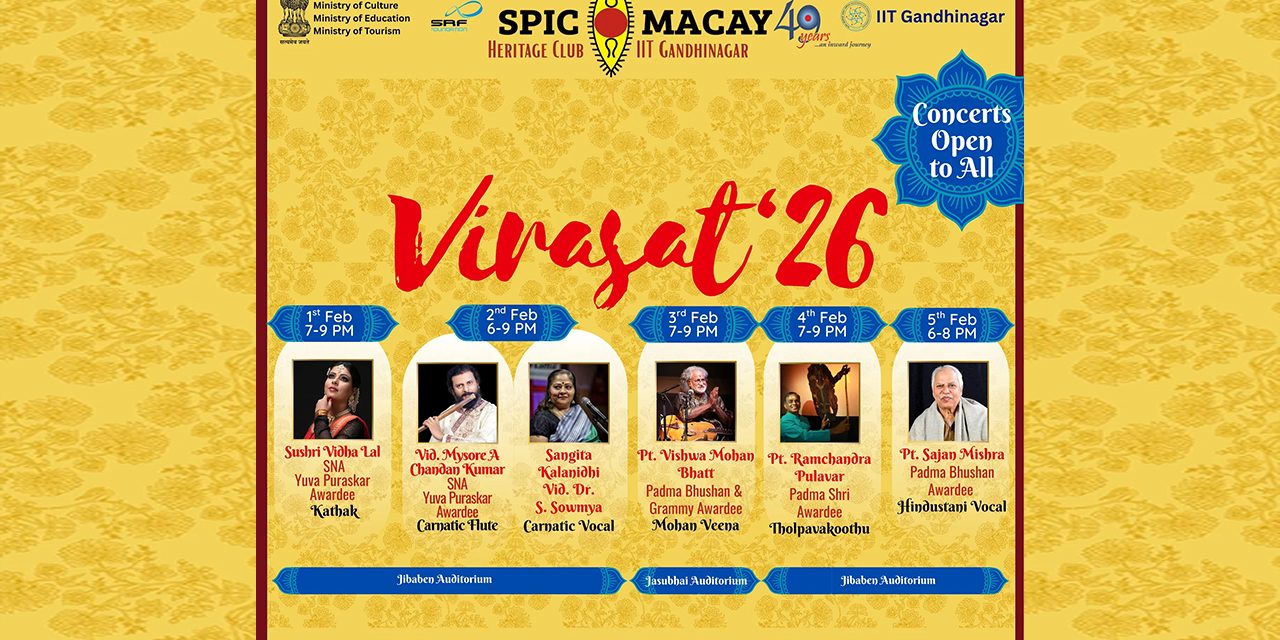
The SPIC MACAY Heritage Club at the Indian Institute of Technology Gandhinagar (IITGN) successfully organised SPIC MACAY Virasat 2026, a vibrant celebration of India’s classical arts and cultural traditions from February 1 to February 5, 2026. The festival brought together eminent artists from across the country and offered students, faculty, and staff a rare opportunity to engage closely with diverse forms of Indian classical music, dance, and traditional storytelling.
Organised in alignment with the vision of SPIC MACAY (Society for the Promotion of Indian Classical Music and Culture Amongst Youth), the festival aimed to deepen young audiences’ appreciation for India’s rich cultural heritage through live performances, workshops, and interactive artistic dialogues.
A Week of Cultural Immersion
The Virasat series at IITGN combined intensive workshops with evening concerts, creating a dynamic cultural environment on campus. While the daytime sessions allowed participants to learn directly from accomplished practitioners, the evening performances featured distinguished artists presenting some of the finest traditions of Indian classical arts.
The concert series opened on February 1 with a Kathak performance by Sangeet Natak Akademi Yuva Puraskar awardee Sushri Vidha Lal and her ensemble at the Jibaben Patel Memorial Auditorium. Known for her mastery of the Jaipur Gharana style, the performance showcased intricate rhythmic compositions, expressive storytelling, and an energetic jugalbandi between the dancer and percussionists. The interactive nature of the recital made the classical dance form particularly engaging for the student audience.
On February 2, the auditorium resonated with the melodies of Carnatic music as two renowned artists took the stage. Vidwan Mysore A Chandan Kumar, a recipient of the SNA Yuva Puraskar, presented a captivating Carnatic flute recital, accompanied by violin, mridangam, and ghatam artists. The evening continued with a powerful vocal performance by Sangeeta Kalanidhi Vidushi Dr S Soumya, whose rendition combined technical brilliance with deep spiritual expression, offering audiences a profound glimpse into the richness of the Carnatic tradition.
The festival continued on February 3 with a memorable performance by Grammy Awardee and Padma Bhushan recipient Pandit Vishwa Mohan Bhatt, the legendary pioneer of the Mohan Veena. Performing at the Jasubhai Memorial Auditorium, Pandit Bhatt demonstrated the unique musical depth of the instrument he created by blending the structure of a Western guitar with the soul of the Indian Veena. The concert featured an enthralling musical dialogue between the Mohan Veena, the Satvik Veena played by Pt Salil Bhatt, and tabla accompaniment. Beyond the music, Pandit Bhatt also engaged the audience in a discussion about the Guru–Shishya tradition and the fundamentals of raga and taal, transforming the performance into an enriching educational experience.
On February 4, audiences witnessed the rare and ancient storytelling tradition of Tholpavakoothu, presented by Padma Shri awardee Vidwan Ramachandra Pulavar and his ensemble. Originating from Kerala, this unique shadow puppetry art form recreated scenes from the Kamba Ramayana through intricately designed leather puppets illuminated by traditional oil lamps behind a translucent screen. The performance offered a powerful visual and narrative experience, transporting viewers into the sacred storytelling traditions of temple theatre.
The Virasat 2026 concert series concluded on February 5 with a spellbinding Hindustani classical vocal recital by Padma Bhushan awardee Pandit Sajan Mishra, a stalwart of the Banaras Gharana. Accompanied by Swaransh Mishra (vocal), Dharm Nath Mishra on harmonium, and Sapan Anjaria on tabla, the maestro delivered a deeply meditative rendition of Raag Shree, followed by a series of bhajans that resonated with devotion and emotional depth. The evening concluded with a standing ovation, marking a memorable finale to the festival.
Intensive Workshops and Artistic Learning
Prior to the concert series, the Virasat workshops were conducted from January 26 to January 30, 2026, with daily sessions lasting three hours. These workshops offered participants hands-on training and insights into traditional art forms under the guidance of expert practitioners.
Indian Classical Music Workshop
A five-day Indian Classical Music Workshop was conducted by Janki Mithaiwala, introducing participants to the foundational elements of the classical music tradition. The sessions focused on concepts such as Sur (musical notes) and Taal (rhythmic cycles), along with the practice of Sargam patterns like Sa Re Ga, Re Ga Ma, and Ga Ma Pa. Participants also explored Aaroha and Avaroha (ascending and descending scales) and rhythmic structures like Rupak Taal, supported by tabla accompaniment that enriched the learning experience.
As the workshop progressed, students applied their learning through a Raag-based composition narrating the life of Lord Krishna, preparing for a final musical presentation. Participants were also introduced to classical instruments like the Tanpura and learned about its handling and significance. Overall, the workshop provided a meaningful introduction to Indian classical music while deepening participants’ appreciation for its discipline and expressive depth.
Kathak Workshop
Under Virasat 2026, the SPIC MACAY Heritage Club at IIT Gandhinagar organized a five-day Kathak Workshop from 26–30 January 2026, led by renowned Kathak exponent Sushri Vidha Lal. The workshop introduced participants to the technical and expressive aspects of Kathak, beginning with basic posture and tatkaar (fundamental footwork) and tracing the historical journey of the dance form from storytelling traditions to court performances.
Participants gradually learned bols, padhant, tukras, todas, and chakkars, developing rhythm, balance, and coordination. A key highlight was the exploration of abhinaya and bhaav through a Ganesh Vandana composition, where students practiced expressing emotions through gestures and facial expressions. The workshop concluded with a final presentation and certificate distribution, leaving participants with a deeper appreciation of the Jaipur gharana style of Kathak.
Kerala Mural Painting Workshop
A five-day Kerala Mural Painting Workshop was conducted by renowned mural artist Sri K R Babu under the SPIC MACAY Intensive Workshop Series. The sessions introduced participants to the history, symbolism, and techniques of the sacred Kerala mural tradition, along with the traditional colour palette derived from natural pigments. Students practiced basic sketching techniques focusing on facial features, proportions, and compositional balance.
As the workshop progressed, participants learned traditional colouring methods including flat colour application, layering, and detailing of ornaments. A significant teaching was the ritual of Kannuthurakkal, the ceremonial painting of the deity’s eyes, symbolising the moment the artwork gains life. The workshop concluded with an exhibition of participants’ artworks, where 17 students presented their completed mural paintings, followed by certificate distribution and an interactive session with the artist.
Yoga Workshop
In addition, a Yoga workshop conducted by Swami Tyagarajananda Saraswati from the Bihar School of Yoga focused on classical yogic practices, combining breathing techniques, meditation, and traditional asanas.
Each workshop began with a traditional lamp-lighting ceremony, symbolizing the beginning of a journey of artistic learning and knowledge.
Cinema Classics Screening
As part of the Virasat 2026 series, a Cinema Classics screening was organised on January 31, 2026 for the IIT Gandhinagar community. The cult film Manthan was screened, offering viewers an opportunity to engage with one of the landmark works of Indian parallel cinema.
The session was followed by an insightful discussion led by Ms Yaatra Khan, Faculty of Film and Video Communication at NID Ahmedabad, who shared critical perspectives on the film’s historical context, narrative style, and its significance in the evolution of socially conscious cinema in India. The discussion encouraged students to reflect on the intersections of art, society, and storytelling in Indian cinema.
Celebrating Cultural Continuity
At the end of the workshop series, participants presented demonstrations of their learning. Yoga participants showcased sequences of asanas, Kathak students performed rhythmic compositions and footwork patterns, vocal participants presented raga-based exercises, and mural painting participants displayed artworks inspired by Kerala’s traditional mural style.
These presentations reflected the enthusiasm and dedication of the participants and highlighted the depth of engagement achieved during the workshop sessions.
A Platform for Cultural Engagement
Through SPIC MACAY Virasat 2026, IITGN once again reaffirmed its commitment to fostering meaningful engagement with India’s cultural heritage. The festival provided a platform for students and the wider campus community to experience the depth and beauty of classical arts while encouraging reflection on the values of discipline, creativity, and cultural continuity embodied in these traditions.