
Author: External Communications

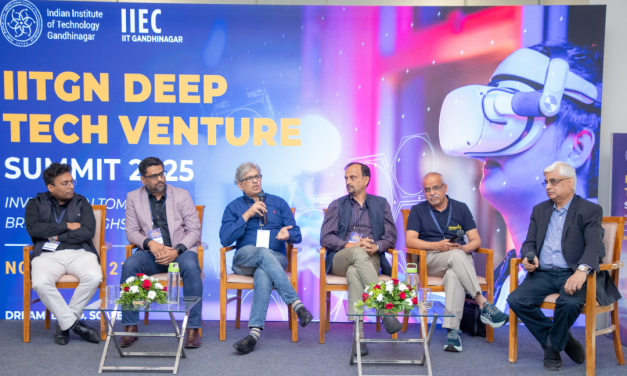
IITGN’s Deep Tech Venture Summit 2025 Showcases India’s Emerging Deep-tech Startups

India Must Build Its Own Critical Technologies for a Self-Reliant Future,” says Shri Kris Gopalakrishnan The Indian Institute of Technology Gandhinagar (IITGN) successfully hosted the Deep Tech Venture Summit 2025 on November 21, 2025, bringing together innovators, investors, and thought leaders to explore the future of deep-tech entrepreneurship. The Summit provided a unique platform for participants to engage with IP-driven startups and connect with IITGN’s dynamic startup ecosystem. Attendees gained insights into emerging deep-tech trends, investment opportunities, and strategies to scale transformative technologies. In his opening remarks, Anand Pandey, Deputy Manager (Commercialization) highlighted the institute’s purposeful journey in building...

Read More
Bridging Gaps in India’s Solar Ecosystem: Insights from ORBIT at IIT Gandhinagar

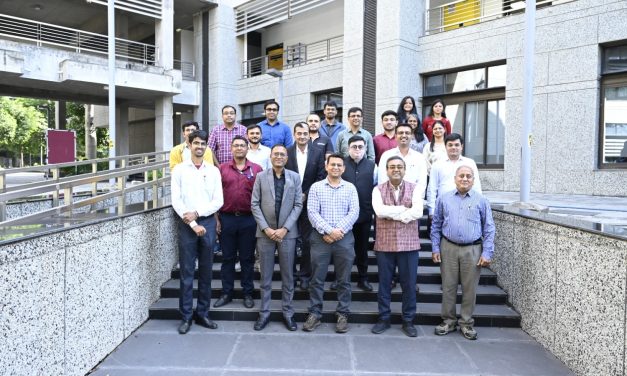
STORY CREDITSWriter: Manasasri Muralidharan and Tanumita MisraPhoto: Arijit Reeves Experts from academia and industry identified challenges in solar manufacturing and discussed collaborative pathways for advancing solar innovation in India. The third edition of ORBIT, conducted by the Indian Institute of Technology Gandhinagar (IITGN) on 8th November 2025, discussed the evolving landscape of solar technology in India. Following earlier editions of the event on biomedical engineering and electric vehicle technologies, the latest session focused on Solar Energy, one of the fastest-growing areas in India’s clean energy transition. The event drew participation from researchers, industry professionals, startups, MSMEs, and large-scale enterprises, serving as...

Read More

IITGN Researchers Propose a New Model of Enzymatic Behaviour that could Transform the Future of Biomedicine

STORY CREDITS Writer: Devki Prabhu Editor: Prof Krishna Kanti Dey Study reveals how enzyme activity can influence surrounding particles in a crowded environment, reshaping our understanding of intracellular motion.  Complexity is what truly defines the human body with its intricate network of biochemical pathways, at the heart of which, are enzymes—proteins that catalyse essential life-sustaining reactions. Much like a toaster that transforms a slice of bread into toast, enzymes convert their substrates into products that power vital cellular functions.  In a recent study, researchers at the Indian Institute of Technology Gandhinagar (IITGN) have uncovered new insights into how enzymes influence...

Read More

A Database of Cancer’s Molecular Mysteries

STORY CREDITSWriter: Tanumita MisraPhoto: Sourced from the article published in Scientific Data  IITGN Researchers Develop An Open-Access Platform, Compiling Structures of Cancer-Linked Regulatory LncRNAs Modern cancer research is advancing towards personalised medicine that addresses the unique molecular characteristics underlying an individual patient’s disease progression. To this end, scientists are exploring unorthodox and intricate regulatory layers that govern cancer cell behaviour. Among these, long non-coding RNAs, or lncRNAs, have attracted tremendous attention, considering their less-understood influence on cancer growth and progression. To address the growing need for integrated studies on these regulatory RNAs, a team of researchers at IIT Gandhinagar...

Read More

IIT Gandhinagar Researchers Develop Sustainable, Non-toxic Water Repellent Coatings for Next-generation Energy Technologies

STORY CREDITS Writer: Manasasri Muralidharan Photo: Envato Stock Image  Developed from clay, plant-derived fatty acids, and cellulose, the new coating is a safe, durable alternative to fluorinated chemicals (per- and polyfluoroalkyl substances (PFAS)) that persist in the environment and threaten human health. The industrial world’s relationship with water-repelling surfaces runs deep. From power plants that require efficient heat transfer to air conditioning systems in massive office buildings, the ability to control how water behaves on surfaces directly translates to increased energy efficiency, reduced costs, and enhanced operational reliability. Yet the very chemicals that enabled these advances have created an environmental crisis,...

Read More