
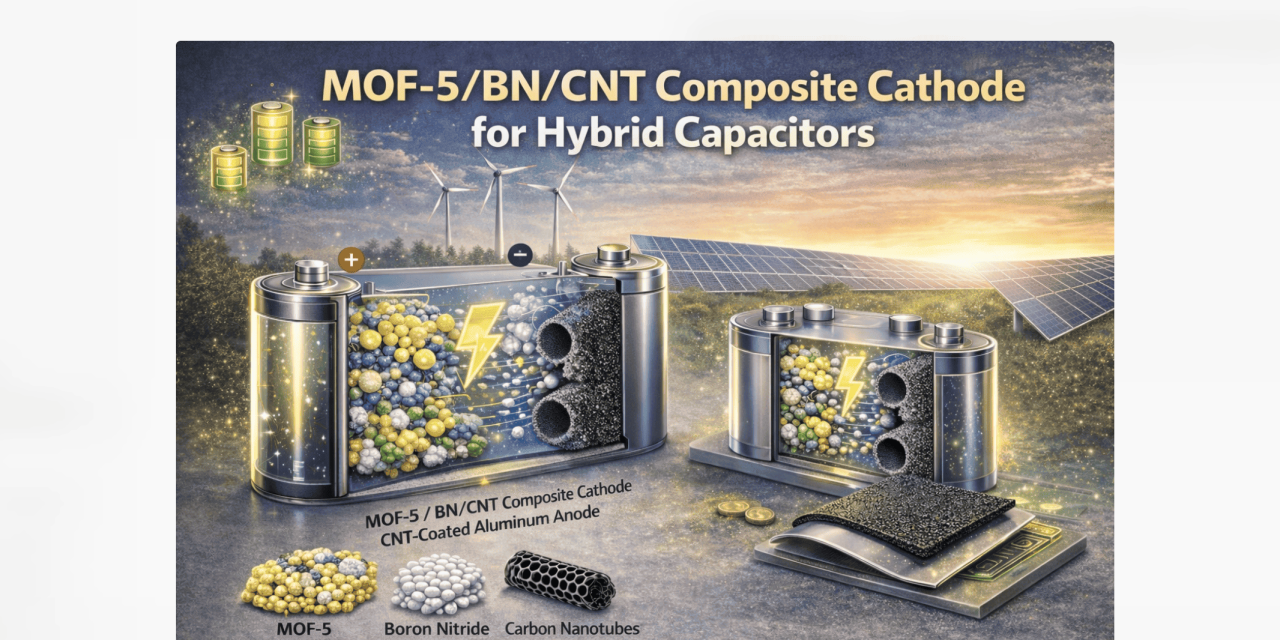
| STORY CREDITS Writer: Apeksha Srivastava Photo: Illustrative image generated using ChatGPT 5.2 |
The world is running towards renewable energy sources: solar panels, wind turbines, and hydro power, among others. However, it is not just about generating clean energy. The bigger question: How to store it smarter for better use! A recent study from the Indian Institute of Technology Gandhinagar (IITGN) takes a step in this direction by rethinking how energy storage devices are built.
Consider this: Although an inverter or battery backup can provide electricity during a power cut, it runs out soon. What if we have systems that not only deliver power quickly but also last longer? Hybrid capacitors are a promising class of advanced energy storage systems that combine the long device function time based on the energy stored and quick energy release features of batteries and supercapacitors, respectively. Aluminium-ion hybrid capacitors (AIHCs) are attracting attention due natural abundance and low cost. However, designing compatible materials with long cycle life and environmental sustainability is a limitation.
The research shows how combining three different materials into a single “hybrid” electrode can improve performance, bringing us closer to fast, durable, and sustainable energy storage systems. The study, recently published in the Journal of Energy Storage, discusses the development of a new cathode material. A cathode can be broadly understood as the side where the energy is stored during charging. The researchers have used metal-organic frameworks (MOF-5), boron nitride (BN), and carbon nanotubes (CNTs) with a CNT-coated aluminium foil anode. The anode is the side that manages the flow of charged particles or energy carriers. MOFs are crystalline materials with adjustable pores and a large surface area that can benefit energy storage applications.
Another issue that the researchers have addressed is related to thermal stability. Most of us have faced the situation when our laptops or phones start heating up while charging. This tends to happen more when we are charging and using the device at the same time. This heat, which slowly damages the device from the inside, is also an issue in the case of energy storage devices. This is exactly where BN enters the scene! In the present study, BN acts as a structural support with its properties of thermal stability and mechanical strength. Further, CNTs form interconnected networks, which can be seen as similar to expressways that efficiently support the movements of high-speed vehicles. CNTs provide exceptional electrical conductivity (movement of charged particles) and mechanical strength.
“The combination of these components resulted in a hybrid material with superior properties. It is highly competitive, excelling in capacity, energy and power densities, and cycling stability. Its performance can be attributed to features like the hybrid and interconnected porous structure and efficient transport of ions or charged particles within the device,” explained Dr Prashant Dubey, the first author of the study. Dr Dubey is a Japan Society for the Promotion of Science (JSPS) postdoctoral fellow at Nagoya University, Japan. He completed this project as an Early Career Fellow at IITGN with Dr Atul Bhargav.
Dr Bhargav is a Professor in the Department of Mechanical Engineering and the Principal Investigator at the Energy Systems Research Laboratory (ESRL). One of his core research interests focuses on building energy and energy use optimisation, which aligns with several Department of Energy and Ministry of New and Renewable Energy initiatives from the Government of India. He is the founder and director of Cellegant Energy Systems, a startup incubated at IIT Gandhinagar Innovation and Entrepreneurship Center. Dr Bhargav is also associated with the Kiran C Patel Centre for Sustainable Development (KPCSD) at IITGN. Speaking about the hybrid device, he mentioned, “An important feature was the use of CNT coatings on aluminium foil. These coatings increase the surface conductivity and cause the aluminium ions to spread evenly during the charge and discharge process. It effectively prevents the corrosion and formation of a thin ‘blocking’ layer on the aluminium surface that is bad at conducting electricity (passivation).” Most of us would have noticed this blocking layer as a reddish-brown crust forming over old plugs, which does not let them conduct electricity well.
The hybrid device significantly outperformed devices that involved individual MOF-5, BN, and CNT. It also stored more than twice as much energy (energy density of 140 Wh/kg) compared to BN-aluminium-based and MOF-5-aluminium-based systems. Further, it maintained a superior energy-releasing capacity (power density of 14.6 kW/kg). Another crucial aspect was the prominent diffusion contribution or the efficient movement of ions or charged particles inside the material, which led to more effective energy storage.
When we buy a new smartphone, one complete charging cycle sustains it for an entire day. However, as the phone gets old, we start charging it multiple times. It shows how rechargeable devices generally slowly lose their ability to hold energy. Interestingly, the assembled device in this study retained 92.2% of its initial capacity even after 20,000 charge-discharge cycles. Such long-term stability is essential for practical energy storage applications.
Aligning with the idea of advanced energy storage systems, this research integrates materials based on their unique features into a device, underscoring its potential for next-generation sustainable and high-performance technologies while overcoming traditional limitations. The researchers acknowledged the Central Instrumentation Facility and Early Career Fellowship from IITGN.
*************************
Information on this research has been covered by the following platforms: