| STORY CREDITS Writer: Corena Pereira |
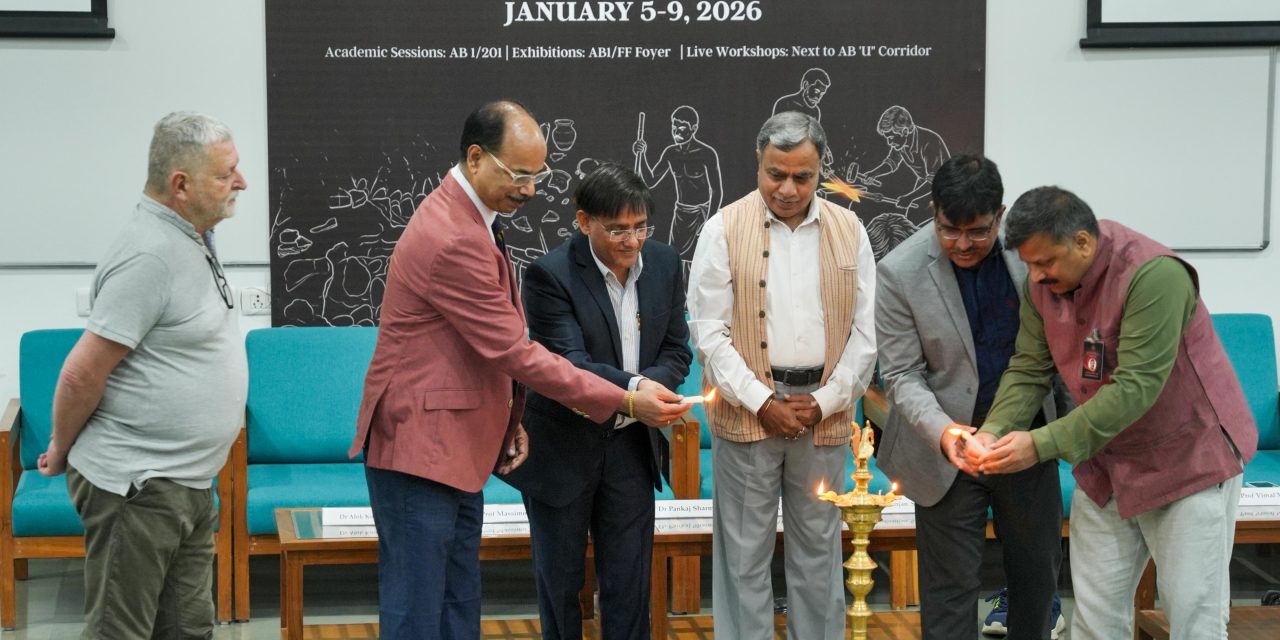
The fourth edition of the five-day International Conference-cum-Workshop under the “History, Science and Technology of Indian Civilisation” series, with a focus on Indian Metals and Metallurgy, commenced today at the Indian Institute of Technology Gandhinagar (IITGN). Being held from 5 to 9 January 2026 on the IITGN campus, the conference has brought together scholars, researchers and practitioners from India and abroad to deliberate on interdisciplinary research in archaeometallurgy.
The inaugural programme featured the presence of Prof Alok Tripathi Director Additional Director General, Archaeological Survey of India, and Prof Jyotiranjan S Ray, Physical Research Laboratory. The session began with a welcome address by Prof Vimal Mishra, Dean (R&D), IITGN, followed by presentations outlining the scope of the conference and broader perspectives on metals and metallurgical traditions. The keynote address was delivered by Prof Massimo Vidale, University of Padua, Italy.
The conference is a continuation of an academic series initiated at IITGN, following earlier editions on Stone Beads (2015), Glass (2019) and Ceramics (2024). The current edition is organised with support from the Anusandhan National Research Foundation, Archaeological Survey of India, Indira Gandhi Manav Sangrahalaya, Gujarat State Directorate of Archaeology and Museums, and the Gujarat Council on Science and Technology.
Academic sessions during the conference will cover themes such as metallurgical traditions, provenance studies, radiometric dating, experimental metallurgy, archaeology of metals, microscopy and microstructure, elemental and isotopic composition, culture contact and trade, pyrotechnology and furnace or kiln engineering, and the diffusion of Indian metals and metallurgical traditions.
The programme also features an exhibition of metal artefacts from ten archaeological sites across North, South and West India, along with selected antiquities from Lothal. In addition, live metal smelting workshops are being conducted by traditional knowledge practitioners from the Deccan, Eastern and Central India.
International scholars participating in the conference include Prof Jonathan Mark Kenoyer, Dr Randall Law, Dr Laure Dussubieux, Dr Stephen Koob and Alan Lee from the USA; Prof Massimo Vidale from Italy; Dr Stéphanie Leroy, Dr Thomas Oliver Pryce, Dr Emmanuelle Delqué-Kolic, Dr Anne Bazin and Prof Bérénice Bellina from France; Dr Vincent Serneels from Switzerland; Dr Brice Girbal from Taiwan; and Dr Daniel Perret from Malaysia.
Indian scholars participating in the conference represent institutions such as the Archaeological Survey of India, Indian Institutes of Technology, Physical Research Laboratory, Indian Institutes of Science Education and Research Mohali, Tamil Nadu State Department of Archaeology, Jadavpur University, Indira Gandhi Manav Sangrahalaya, Odisha Research Centre, and the Gujarat State Directorate of Archaeology and Museums. Participants include Shri Y S Rawat, Dr Bhuvan Vikrama, Dr Shubha Majumdar, Prof K Rajan, Dr V Selvakumar, Prof Jeewan Singh Kharakwal, Prof Sharada Srinivasan, Prof Sukanya Sharma, Prof Rajib Dey, Dr Anuradha Panda, Dr Oishi Roy, Dr Amit Arora, Dr Gautam Anand, Prof Alok K Kanungo, Dr Sriperumbudur Jaikishan, Prof Ambika Patel, Prof Kishor K Basa, and Dr Pankaj Sharma, among others.
All sessions include time for discussion and interaction. A one-day field visit to Vadnagar has also been planned, during which participants will visit the Vadnagar Archaeological Experiential Museum and engage with site interpretations and conservation initiatives.
The conference aims to promote academic exchange, mentorship, student engagement and professional collaboration. The event will continue until 9 January 2026, and a detailed programme is available on the conference website.