
For most of us, the humming overhead wires that power our cities are invisible until they fail. But for power distribution companies, they represent a massive logistical nightmare. In a country with over 5 lakh kilometres of overhead power lines, maintaining the grid is a high-stakes, high-cost endeavour. Current inspection methods are fraught with danger and expense. Human workers risk their lives scaling towers, while industrial drones are costly and suffer from limited battery life.
For a pair of undergraduate students from the Mechanical Engineering Department of the Indian Institute of Technology Gandhinagar (IITGN), this industry conundrum became the point of innovation. “It began as a routine course assignment at IITGN, ‘Find a real-world problem and build a working prototype to solve it,’” said Nikhil Kumar Lal, a final-year BTech student. Their journey began with a broad exploration of infrastructure challenges, from underground pipelines to mechanical systems, before converging on the challenge of overhead power-line inspection. As they dug deeper, the scale of the issue became clearer. “Approximately 30 per cent of power loss in the power grid system stems from line failures, and roughly 80 per cent of these failures are attributable to faulty lines that have deteriorated over time,” added Manas Kalal, a fourth-year BTech student and the other half of the innovative duo.
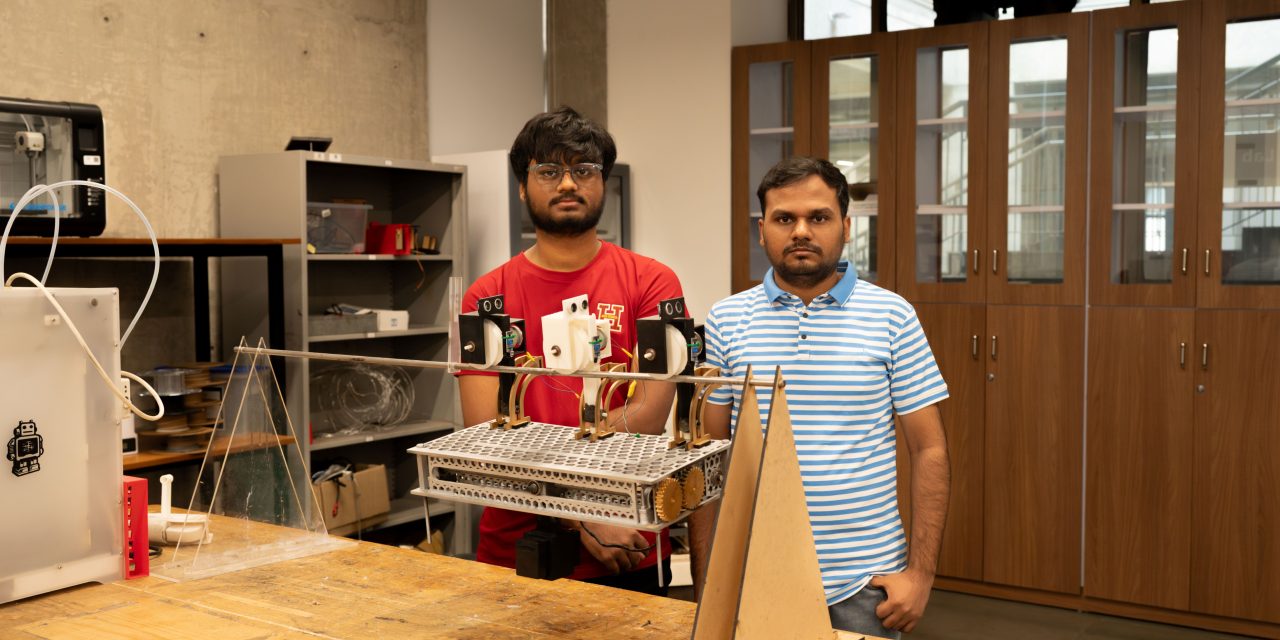
The breakthrough came when they fundamentally rethought the inspection process. Instead of flying above the lines or placing humans directly on them, they asked a simpler question: why not use the wire itself as the pathway? Working out of IITGN’s Tinkerer’s Lab, with basic levelling and machining tools, a 3D printer, and sustained mentorship, the team began developing a robot capable of crawling directly along high-voltage power lines.
Unlike drones, which fight gravity and run out of battery quickly, the robot was designed to utilise the wires of high-voltage power lines as its transportation track and traverse them autonomously. Equipped with a thermal camera and a basic visual camera, the team created a robot that could detect hotspots or areas of heat generation on the lines caused by resistance, damage, or material degradation.
One of the first engineering hurdles was continuity. Power lines are punctuated by support structures, insulators, and junctions, making uninterrupted inspection difficult. “A robot can easily roll along a straight wire,” explained Nikhil, “but without the ability to bypass obstacles, inspection remains limited.” To address this, the team developed a mechanism that allows the robot to disengage, navigate past obstructions, and re-engage with the line.
Stability posed an equally significant challenge. Unlike controlled laboratory setups, real-world power lines sway with the wind and curve across long spans. “Excessive vibration can cause the robot to lose contact or topple,” said Manas. To counter this, the team designed a suspension and wheel-engagement system that carefully managed the robot’s centre of mass, complemented by a lead-damping mechanism to reduce oscillations.
The team credits Dr Madhu Vadali, Associate Professor at IITGN’s Department of Mechanical Engineering, for helping them identify the engineering problems and guiding them through the trial-and-error processes of finding novel solutions. “Manas and Nikhil worked over the course of 10 months to speedily transform their idea into a tangible prototype,” remarked Dr Vadali, who conducted weekly meetings to help the duo ideate, design, and execute their vision. Long hours in the lab translated into iterative refinements. When wind or vibration destabilised early versions, the team responded by redesigning the robot’s arms, adjusting battery placement, and recalibrating weight distribution. The incremental changes steadily improved the prototype’s reliability.
According to Dr Vadali, one of the most compelling aspects of the innovation is its affordability. While industrial drones used for line inspection can cost between Rs 50 lakh and Rs 60 lakh, the team developed its prototype for approximately Rs 15,000, estimating a final market-ready cost of Rs 3 – 4 lakh. Recognising this potential, Infineon Technologies India Private Limited selected the team under its national CSR initiative, which supports young innovators, providing funding of Rs 5,00,000 to advance the project. They received an additional funding of Rs 62,500 from Hyundai Motor Group. “This support has given us the confidence and resources to move beyond a lab prototype and think seriously about real-world deployment,” said Manas. “To support our future commercialisation plans, we have filed a provisional patent and aim to submit a final application by 2026,” said Manas.
The team’s immediate focus is refining the mechanics to handle the natural curvature or sag of real-world wires and developing a shielding system to protect the robot’s electronic components from the high-voltage electromagnetic fields found on active grid lines. By reducing costs by nearly 90% compared to drones and eliminating the safety risks associated with manual labour, this innovation could open the door to more frequent inspections and a more reliable power grid for both urban and rural India.
Expanded sensing capabilities and partnerships with companies could transform the robot into a comprehensive grid diagnostic platform. The team is currently seeking industry collaboration to test the prototype in real-world scenarios and refine their business model. “We have the mechanical innovation, but we need user insights,” added Nikhil. As he and Manas gradually move towards real-world deployment, the project – marked by failed prototypes, long nights in the lab, and incremental breakthroughs – has been a learning journey. Each redesign brought them closer to a solution that could reduce risk for workers, lower costs for utilities, and improve power reliability for millions.
Their work highlights how student-led innovation, when supported by mentorship, infrastructure, and industry collaboration, can evolve from a classroom assignment into a solution with the potential for national impact.