
|
STORY CREDITS Writer: Corena Pereira Photo: Megh Modi |
Indian Forest Service Officers Training Workshop under the aegis of MoEFCC on the theme “Conserving Blue Ecology for a Sustainable Blue Economy”
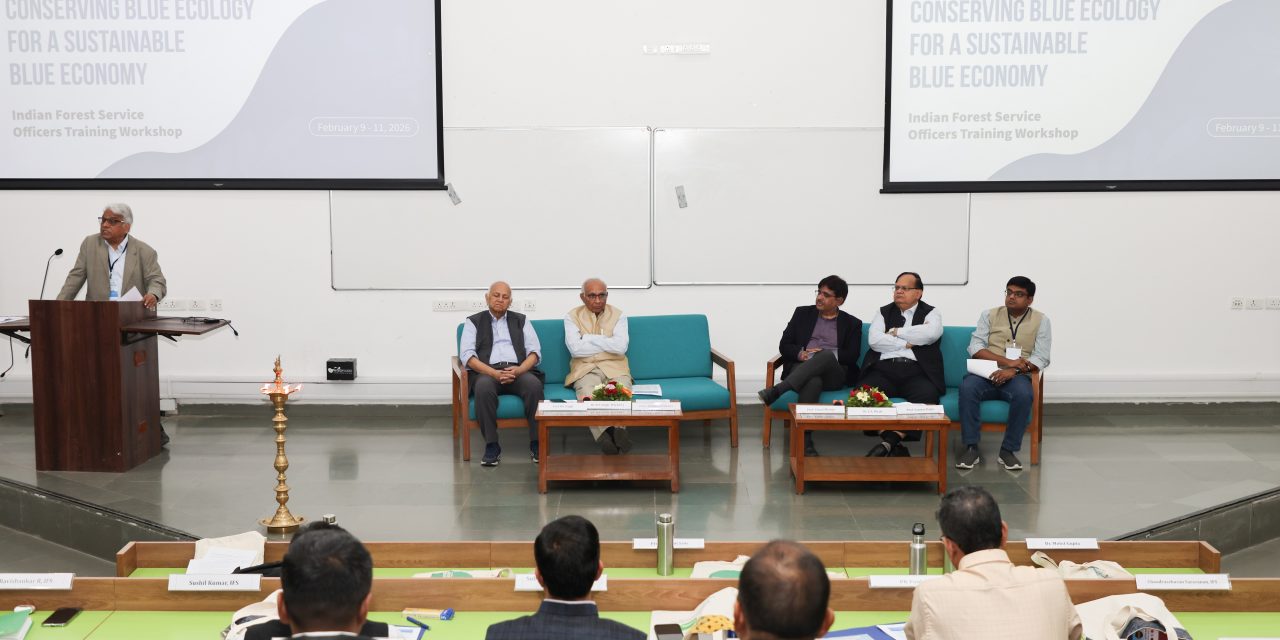
The Indian Institute of Technology Gandhinagar (IITGN) commenced a three-day national training workshop for Indian Forest Service (IFS) officers on “Conserving Blue Ecology for a Sustainable Blue Economy” from February 9 to 11, 2026. The programme is being organised by the Dr Kiran C Patel Centre for Sustainable Development, IITGN, with support from the Ministry of Environment, Forest and Climate Change (MoEFCC), Government of India.
The workshop opened with an inaugural session introducing participants to the concept of blue ecology and its relevance to India’s coastal and marine governance. Experts highlighted the need to balance ecological conservation with economic activities linked to oceans, coasts, wetlands, and inland water systems, while strengthening capacities for the sustainable management of blue resources through integrated policy, livelihoods, and cross-sectoral collaboration.
Welcoming and introducing the distinguished guests, Prof C N Pandey, Professor of Practice, Earth Sciences (jointly with the Humanities and Social Sciences Department, IITGN), said, “Long-term development is possible only when economic growth is aligned with the biological capacity of ecosystems.” He highlighted the importance of sustainable and green economic thinking and urged participants to view themselves as responsible managers of natural resources while working towards inclusive growth and environmental balance.
“This programme gives us a chance to pause, reflect and reconnect with nature. Development is necessary, but the real question is what kind of development we pursue. Excessive consumption, climate change and unsustainable patterns are already impacting our environment. India holds a unique ecological and cultural diversity, and despite our differences, we have always believed in living together with shared values. We should understand where we come from and where we are going,” said Dr J R Bhatt, Member, Central Empowered Committee (Constituted by the Hon’ble Supreme Court of India), eminent Scientist and an internationally acclaimed expert on climate change and biodiversity, while addressing the participants.
Speaking at the inaugural session of the training programme on sustainable development and environmental governance, Dr H S Singh, former PCCF and Chairman, Gujarat Biodiversity Board, emphasised the need to balance development with conservation.
“Development and environmental protection must go hand in hand. Gujarat has shown that wildlife conservation and growth can coexist, whether in protecting forests, water resources, or biodiversity. Scientific research, policy support, and community participation are critical to addressing climate change, species loss, and ecological imbalance. Knowledge must reach the local level so that conservation efforts become sustainable and effective,” said Dr Singh.
Speaking during the inaugural session, Prof R N Singh, Visiting Professor at IITGN, said, “Interdisciplinary learning and sustained engagement are essential to address real-world challenges. Such academic interactions provide a valuable platform to exchange ideas, strengthen systems thinking, and collaboratively work towards practical and innovative solutions across domains.”
“Sustainable development is not easy to understand unless we also understand ecology. Ecology is linked with water quality, food quality and the living environment around us. Any problem in water, pollution, or climate change directly affects ecosystems and, in turn, human health and the economy. That is why understanding ecosystem services and sustainability is extremely important today,” said Prof Vimal Mishra, Dean (Research & Development), IITGN, while addressing participants.
The three-day workshop is structured to move from foundational concepts to applied learning and practical implementation. Sessions cover marine and coastal ecosystems, wetland conservation, biodiversity governance, fisheries management, blue carbon, marine protected areas, and integrated coastal zone management. The programme also includes interactive discussions on governance tools and community engagement, along with a field visit to the Aquatic Gallery at Science City, Ahmedabad.
Delivering the vote of thanks, Prof Sameer Patel, Assistant Professor, Civil Engineering (jointly with the Chemical Engineering Department, IITGN), emphasised the value of academic collaboration in addressing sustainability challenges. “Such programmes create an important platform for knowledge-sharing among participants and experts, strengthening efforts towards sustainable development and the blue economy,” he said.
A total of 27 IFS officers from across ten states and UTs across India, are participating in the workshop, which aims to strengthen field-level decision-making and promote effective conservation of India’s coastal and marine ecosystems.