
| STORY CREDITS Writer: Manasasri Muralidharan and Tanumita Misra Photo: Arijit Reeves |
Experts from academia and industry identified challenges in solar manufacturing and discussed collaborative pathways for advancing solar innovation in India.
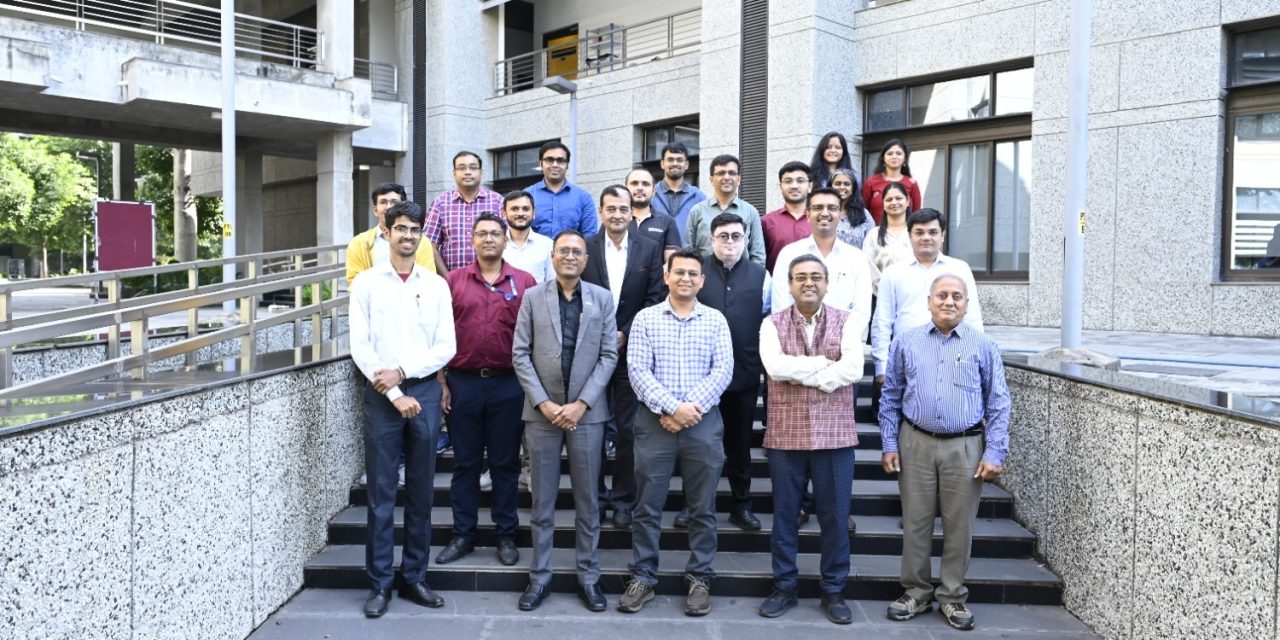
The third edition of ORBIT, conducted by the Indian Institute of Technology Gandhinagar (IITGN) on 8th November 2025, discussed the evolving landscape of solar technology in India. Following earlier editions of the event on biomedical engineering and electric vehicle technologies, the latest session focused on Solar Energy, one of the fastest-growing areas in India’s clean energy transition. The event drew participation from researchers, industry professionals, startups, MSMEs, and large-scale enterprises, serving as a critical platform to brainstorm challenges, share operational insights, and identify avenues and use cases for industry-academia collaboration.
Dr Soumyadip Sett, Assistant Professor (Mechanical Engineering) and faculty-in-charge of IITGN’s Industry Relations Team, opened the proceedings by detailing the various avenues through which IITGN facilitates industry collaborations. He highlighted the role of Research Park, the Incubation and Entrepreneurship Center, student teams, and faculty cohorts in the existing industry-academia partnerships at the Institute. Building on this introduction, Dr Anagh Bhaumik, Assistant Professor (Materials Engineering) and the faculty lead of the event, set the stage for further discussions. Remarking on India’s current reliance on imports for critical solar materials, such as polysilicon, wafers, and cells, Dr Bhaumik noted that manufacturing efficient and affordable solar-grade raw materials could transform the national economy. He also mentioned IITGN’s advanced fabrication and characterisation facilities, which can aid in prototyping, testing, and scaling new solar materials and modules.
Discussions with industry participants addressed Gujarat’s leadership in renewable energy and its roadmap toward net-zero emissions by 2047. Representatives from Gujarat Urja Vikas Nigam Limited’s GETRI unit discussed the state’s unique potential for deploying Concentrated Solar Power (CSP) systems in regions with high direct normal irradiance. Additionally, they highlighted the complementarity of CSP with photovoltaic (PV) and battery storage systems. The delegates also pointed out that while India has made impressive progress in PV deployment, its solar portfolio must diversify. They called for more pilot projects integrating CSP, PV, and Battery Energy Storage Systems (BESS) to address intermittency, improve grid reliability, and enable hybrid models suited for large-scale and decentralised power generation.
Participants also exchanged real-world insights from implementation projects, including solar irrigation systems, rural electrification, and the use of IoT-enabled monitoring tools for solar assets. Challenges such as inadequate maintenance practices, a shortage of skilled technicians, and the need for performance validation at the field level were discussed. The cohort also touched upon the need for systemic improvements to overcome challenges in data acquisition from solar installations, the lack of open-technology infrastructure, and the need for comprehensive policy frameworks.
The session concluded with deliberations on potential use cases and collaboration opportunities. These were presented by representatives from the Gujarat Energy Training & Research Institute, Navitas Solar, Prozeal Energy, Urjavinya Power Solutions, Enlec Solutions, AAPLUG System, Kosol Energie, and Nessa Illumination Technologies. They expressed interest in leveraging IITGN’s research facilities, Research Park, and Centre for Research Commercialisation (CRC) for co-developing prototypes and testing new materials.
The discussions conducted that took place at ORBIT emphasised the need for joint R&D programs, industry-supported capstone projects, and shared infrastructure to accelerate India’s solar innovation pipeline.