
| STORY CREDITS Writer: Manasasri Muralidharan Photo: Arijit Reeves |
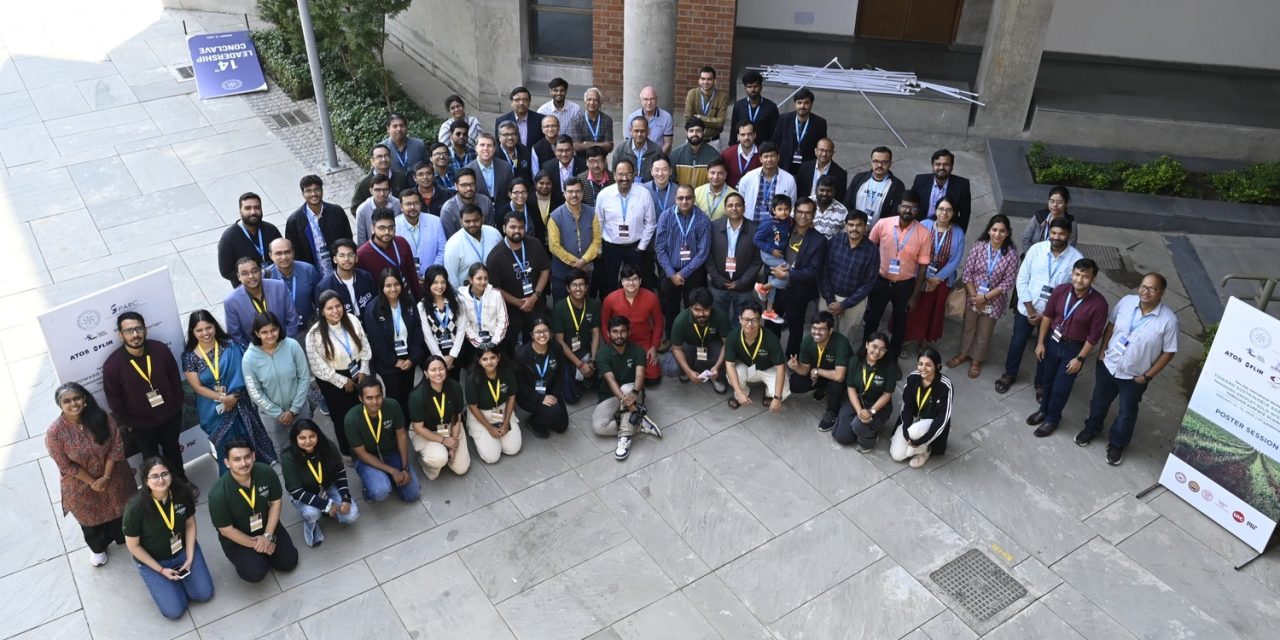
International and national experts from India, Europe, and the United States of America convened at IITGN to discuss how droplet science and surface engineering could transform pesticide use and agricultural efficiency.
As climate variability, rising input costs, and ecological concerns reshape agricultural practices worldwide, researchers are increasingly turning to fundamental science to address some of the domain’s most pressing challenges, including food security, environmental sustainability, and the efficient use of water and agrochemicals. Against this backdrop, the Indian Institute of Technology Gandhinagar (IITGN) concluded a two-day international workshop on January 13, 2025, titled “Toward Sustainable Agriculture: Managing Droplet–Solid Interactions through Surface Science.”
Organised under the Ministry of Education’s Scheme for Promotion of Academic and Research Collaboration (SPARC) initiative, the event fostered interdisciplinary dialogue and established collaborative research networks to address fundamental challenges in sustainable pesticide application and agricultural innovation. The workshop was co-led by a host of national and international institutions from India and the United States of America. The organising team comprised principal investigators Prof Ranjan Ganguly (Jadavpur University) and Prof Constantine M Megaridis (University of Illinois Chicago), and co-leads Prof Soumyadip Sett (IITGN) and Prof Pallab Sinha Mahapatra (Indian Institute of Technology Madras). International SPARC collaborators who provided strategic support included Prof Jonathan B Boreyko (Virginia Polytechnic Institute and State University (Virginia Tech)), Prof Sunghwan (Sunny) Jung (Cornell University), and representatives from the Massachusetts Institute of Technology.
The workshop brought together researchers from India and abroad, industry practitioners, and agricultural experts to explore how the behaviour of liquids, such as pesticide sprays, irrigation droplets, and rain, on plant surfaces can influence crop health, resource efficiency, and environmental impact. During the inaugural session, Prof Soumyadip Sett welcomed participants and highlighted the importance of interdisciplinary and international research in addressing agriculture-related sustainability challenges. Speaking about the increasing emergence of innovations at the intersection of engineering, material science, data analytics, and agricultural science, Prof Vimal Mishra, Dean, Research and Development at IITGN, noted, “Meeting food security demands for over 1.4 billion people while simultaneously minimising chemical inputs and maintaining environmental stewardship is challenging. Platforms such as this workshop could foster meaningful dialogue across disciplines, enabling innovations that address food security, climate variability, resource efficiency, and environmental sustainability.”
Over the course of two days, the workshop featured a series of technical sessions, plenary lectures, flash talks, poster presentations, and discussions. The six technical sessions hosted talks that connected fundamental droplet physics with real-world agricultural applications. Prof Saptarshi Basu (IISc Bengaluru) and Prof Amitava Datta (Jadavpur University) unpacked how sprays are formed and how droplets break, move, and settle in the air, processes that determine whether agricultural sprays reach crops efficiently or are lost to drift and evaporation. Their talks showed that controlling droplet size and behaviour at the source is central to reducing chemical wastage and improving precision in farming.
Building on these fundamentals, Prof Cameron Tropea (Technische Universität Darmstadt, Germany) and Dr Sujoy Saha (ICAR-National Research Centre for Grapes) demonstrated how engineering design can actively control droplet size in agricultural sprays, offering practical pathways to limit spray drift, lower environmental contamination, and reduce excess pesticide use. These concerns are increasingly critical for sustainable agriculture in India and globally.
Bringing an engaging interdisciplinary lens, Prof Sunghwan (Sunny) Jung (Cornell University) illustrated complex droplet ejection and transport using the everyday example of onion cutting. His talk highlighted how insights from familiar phenomena can deepen scientific understanding of how liquids interact with plant and food surfaces. Prof Jonathan B Boreyko (Virginia Tech) presented how infected plants naturally “sneeze” to spread disease. His talk revealed how tiny, jumping droplets formed during condensation can unintentionally spread plant diseases, drawing attention to overlooked physical pathways in crop health management. Complementing this, Prof Amit Agrawal (IIT Bombay) explained how fluid flow through textured microchannels can be harnessed to improve liquid transport and delivery systems, with implications for agriculture as well as energy and thermal management.
The plenary sessions further broadened the discussion by linking surface science to challenges in crop protection, weed management, and emerging agricultural technologies. Prof Constantine Megaridis (University of Illinois Chicago) spoke on how surface roughness affects friction and liquid motion. He explained the mechanism by which microscopic features on a surface could dramatically alter how liquids stick, slide, or spread. These insights are relevant for designing smarter agricultural sprays and crop-protection technologies.
Beyond individual talks, a panel discussion on “Bridging laboratory innovations and field-level applications” examined how multidisciplinary research can accelerate the translation of scientific insights into deployable solutions for sustainable crop protection. The panel, moderated by Prof Jaywant Arakeri (IISc Bengaluru), featured Prof Amitava Datta, Prof Jonathan Boreyko, Prof Sunny Jung, Dr Kaushik Banerjee (ICAR-NRCG), Dr Rupak Paul (Rallis India Limited), and Prof Susmita Dash (IISc Bengaluru). Panellists noted that inefficient pesticide application – due to poor retention and uneven coverage – drives pest resistance, environmental contamination, and food safety risks. Addressing these issues, they said, requires a holistic approach that brings together surface science, fluid mechanics, plant biology, formulation chemistry, and emerging technologies such as sensors, artificial intelligence, robotics, and drone-based spraying.
The discussion also traced the transition toward “Agriculture 4.0,” emphasising data-driven and autonomous decision-making, while cautioning that solutions must be adapted to Indian realities, including small landholdings, variable water quality, and diverse cropping systems. A recurring theme was the need to bridge laboratory research with field validation by involving farmers early, integrating traditional knowledge with scientific advances, and ensuring economic viability. Strong collaboration across academia, industry, and farming communities was identified as critical to translating innovation into scalable and sustainable agricultural practice.
The workshop also featured flash talks by sixteen early-career scientists and twenty-two student poster presentations, providing a platform for young researchers to showcase their ongoing work. To recognise excellence and encourage emerging talent, six poster awards were presented across two categories – faculty/scientists and students. The sessions encouraged cross-disciplinary dialogue on topics such as controlled-release nanopesticides, water-repellent surfaces, AI-enabled diagnostics, and precision spraying systems. Emphasising the importance of such formats, Prof Pallab Sinha Mahapatra noted, “Such sessions reinforce SPARC’s emphasis on capacity building by equipping the next generation of researchers with the skills to build professional networks, communicate science effectively, and cultivate curiosity at the interface of engineering and agricultural science.”
Supported by ANRF and the Gujarat State Biotechnology Mission (GSBTM) under the Department of Science and Technology, Government of Gujarat, and sponsored by ATOS Instruments, Phantom AMETEK, and Springer, the workshop reflected India’s growing commitment to science-driven, sustainable agricultural development. As noted by Prof Ranjan Ganguly, the workshop was designed as an interactive platform for idea exchange. “Sustainable agriculture cannot be achieved in silos; it requires co-creation of solutions grounded in real field challenges. The objective of this workshop was to advance scientific understanding and build a shared language between engineers, plant scientists, and agricultural practitioners,” he said.
Through this workshop, the IITGN team, comprising Prof Sett, Prof Subramanian Sankaranarayanan, Prof Sriharitha Rowthu, and Prof Uddipta Ghosh, reaffirmed the Institute’s role as a hub for interdisciplinary research, global collaboration, and commitment to promoting the Sustainable Development Goals set by the United Nations and the Government of India.