
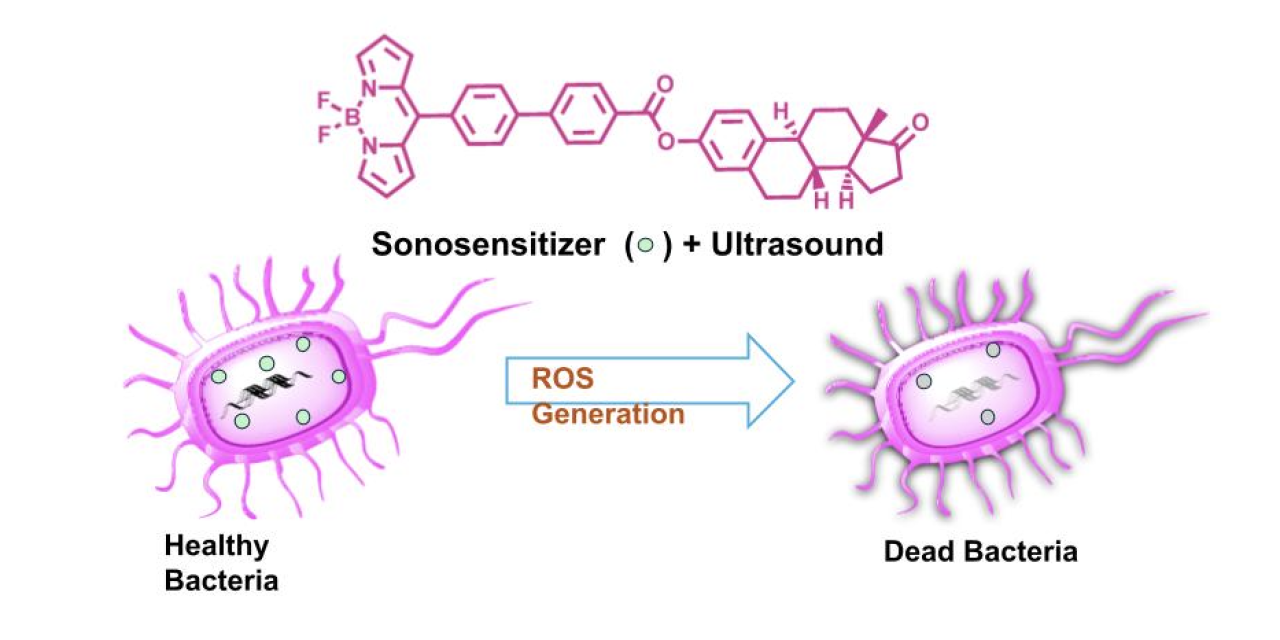
| STORY CREDITS Writer: Apeksha Srivastava Photo: An overview of the study (Synthetic Pigments Lab) |
Antibiotics have been a marvel for us. They have treated a variety of conditions, ranging from common throat ailments to deadly diseases like meningitis and tetanus. However, doctors worldwide are now increasingly encountering bacteria that are fighting back against the antimicrobial agents and not responding to treatment. This phenomenon, known as antimicrobial resistance (AMR), is making routine infections harder to treat. Imagine a person with an implant infection is not healing because the stubborn bacteria are blatantly unresponsive to antibiotics. What about a person with a urinary tract infection having bacteria that are resistant to several kinds of antibiotics? In many cases, these ineffective treatments threaten the lives of people.
Researchers from the Indian Institute of Technology Gandhinagar (IITGN) have demonstrated the feasibility of using estrone-linked BODIPYs sonosensitizers for antimicrobial sonodynamic therapy (SDT). Their initial findings were published in Chemistry – An Asian Journal.
Instead of using antibiotics to block bacterial growth, SDT is a promising strategy that uses ultrasound to activate agents called sonosensitizers. Sonosensitizers produce reactive oxygen species (ROS) that seriously damage the bacteria from multiple angles! Since the attack happens on multiple bacterial components, such as its genes, proteins, and outer layer, it becomes very difficult for the bacteria to develop resistance. We can think of it as attacking a fort from multiple directions instead of a single entry point. A major advantage of ultrasound is its ability to reach several centimetres into tissues, making SDT a viable option for combating localised deep-seated infections that may be otherwise challenging to treat.
When the ultrasound moves through liquid, it generates and rapidly collapses bubbles, a process known as cavitation. The collapse of bubbles releases bursts of energy that can split water molecules into components, reacting with oxygen to form oxidative species (ROS), which act like lethal weapons for killing bacteria. The collapsing bubbles can also release microscopic flashes of light (sonoluminescence). These events activate the sonosensitizers and help generate the bacteria assassins, ROS.
It is important to note that the success of SDT depends on the choice of sonosensitizer. “Although we have materials like titanium dioxide nanoparticles that can generate ROS effectively, there are concerns regarding their safety and accumulation in the body. In contrast, while certain dyes are considered safe, they often do not respond adequately to ultrasound,” explained Arjun Siwach, a PhD student in the Department of Chemistry at IITGN.
Enter boron-dipyrromethene (BODIPY) dyes, a highly promising candidate for SDT! Their derivatives have been explored in photodynamic cancer therapy, which involves the use of light-activated drugs for targeting and destroying cancer. These dyes also glow brightly upon light exposure, which helps spot cancer cells without invasive cuts (bioimaging). Further, researchers can tweak their structure and change how they absorb energy and produce ROS. However, their systematic exploration in terms of antibacterial SDT remains limited.
The IITGN researchers designed BODIPY molecules linked to estrone. Esterone helps efficiently tackle the Gram-negative bacteria, such as Escherichia coli. These bacteria have two membranes that act like security guards and block most water-repelling and bulky molecules. This double-layered wall acts as a barrier and is a major contributor to antibacterial resistance. In such a case, esterone comes to the rescue! It can help BODIPY molecules associate with and penetrate the bacterial membrane. So, basically, estrone is a passkey that can assist the ‘killers’ in getting closer to their bacterial target.
The team synthesised four estrone-linked BODIPY derivatives with different linkers between the estrone unit and the BODIPY. The derivatives absorbed and emitted light at longer wavelengths. It indicated that the estrone and the linker influenced the overall structure of the BODIPY, influencing the production of ROS for killing bacteria after exposure to light.
Dr Iti Gupta, Professor in the Department of Chemistry at IITGN and the Principal Investigator at the Synthetic Pigments Lab, described, “Our experiments showed that EBD-1 was the best performing derivative as it generated a significant amount of ROS capable of killing bacteria after exposure to ultrasound. Antibacterial activity against the Escherichia coli bacteria revealed that a combination of ultrasound, EBD-1, and clinically approved microbubbles eliminated 99.9% of the bacteria.” Simply put, microbubbles are tiny, gas-filled bubbles with a protein or lipid shell. They act as cavitation nuclei and intensify the bubble generation and collapse effect. Interestingly, monitoring across all experimental conditions showed that the temperature remained below 42°C, indicating that the antibacterial activity was primarily chemical and mechanical rather than thermal.
“This research shows the feasibility of using a combination of cell-penetrable BODIPY and ultrasound-driven cavitation for antibacterial SDT. If these laboratory findings show similar trends in future clinical trials, this approach could develop as an encouraging alternative to treat localised resistant bacterial infections,” said Dr Himanshu Shekhar, Associate Professor in the Department of Electrical Engineering at IITGN and one of the Principal Investigators at the Medical Ultrasound Engineering Laboratory. Such research is the need of the hour, as it aligns with the National Action Plan on Antimicrobial Resistance (2025–2029). This initiative by the Government of India is a multisectoral ‘One Health’ mission to combat the severe threat of drug-resistant bacteria through effective surveillance, information dissemination, and innovative research.
Future research can focus on exploring the optimal design of sonosensitizers and combinational treatment strategies, including the microbubble type and acoustic conditions, to name a few parameters. Further, the present work needs to be validated in animal and clinical trials for this approach to be translated to the clinic. The researchers acknowledged IIT Gandhinagar, Anusandhan National Research Foundation, Department of Biotechnology, and the Scheme for Transformational and Advanced Research in Sciences (STARS) programme (Ministry of Education) for funding support.
*************************
Information on this research has been covered by the following platforms:
- Phys.org
- Press Information Bureau
- Navjeevan Express
- The Live Ahmedabad
- BW Education
- drugscontrol.org
It has also been published in print by Gujarat Samachar.