
| STORY CREDITS Writer: Manasasri Muralidharan Photo: Arijit Reeves |
At the student-led fireside chat, the veteran venture capitalist reflected on growing up as a first-generation learner and the necessity of resilience, failures, and discomfort on the road to success.
In an era where the race for campus placements often dominates student life, Silicon Valley pioneer and IIT alumnus Mr Kanwal Rekhi returned to his roots to deliver a different message, “Stop being job takers and start being job makers”. Speaking to a packed audience in IIT Gandhinagar’s Jagdish Patel Learning Theatre, the student-moderated fireside chat with Mr Rekhi evolved into a masterclass on uncertainty, failure, self-reliance, and the “radical decision” to take full responsibility for one’s own destiny.
The evening’s chat, titled “Thinking Big, Building Bold,” moved beyond the conventional entrepreneurship narrative to explore how personal resilience, market observation, and first-principles thinking create the conditions for sustained innovation. Drawing from his early life, Mr Rekhi reflected on growing up amid constant movement, financial constraints, and the experience of being a first-generation learner. He emphasised that resilience is often born from necessity and credited his mother’s unwavering faith for his early confidence, noting that his upbringing taught him to find agency even when resources were scarce.
“I internalised early in life not to blame anyone else or my circumstances,” he told the students, adding that being underestimated as a young immigrant, part of the “$8 Men” who left India with nearly nothing, actually served as a competitive advantage. His candid recollections resonated deeply with the IIT Gandhinagar audience, especially the student community, many of whom are carrying first-generation aspirations and navigating expectations from family, the institution, and the market.
The conversation traced Mr Rekhi’s journey from IIT Bombay, where he described himself as quiet, self-driven, and deeply drawn to abstract thinking, to the United States, where he encountered computing, programming, and the realities of professional instability. Reflecting on his early professional hurdles, including being laid off, he spoke candidly about how failures were part of his journey to success and acted as catalysts for independence. “After my layoff, I decided that nobody would ever own my career, except myself.”
Speaking at length about his transition into Silicon Valley, Mr Rekhi spoke of entrepreneurship as a deeply personal decision shaped by responsibility, risk, and timing. He described the moment he asked himself, “Why not me?”, which led to the founding of Excelan, one of the early companies to commercialise high-performance Ethernet networking. He urged students to look at global problems, from infrastructure to AI, as personal invitations to innovate. When asked about leading through a crisis, Rekhi emphasised returning to basics: “Ask why is that so? Understand how the systems work, and ask what you need to do to make it work.”
As the session expanded beyond individual careers to examine India’s broader innovation and entrepreneurial ecosystem, Mr Rekhi encouraged students to think of themselves not merely as job seekers, but as problem solvers capable of creating value in their own communities. He highlighted how technological tools, access to knowledge, and the free exchange of ideas can empower young people to build solutions at scale when paired with initiative and persistence.
Mr Rekhi painted a vision for India’s future, suggesting that the country’s greatest resource is no longer just its brainpower, but its growing “faith in its own people.” He outlined a growth trajectory for the nation that reflects achievement and ambition. “We began with 500 startups and have almost 200,000 of them now! Hopefully, we might have 10 million entrepreneurs by 2047!” he remarked. This ambitious vision of Mr Rekhi is rooted in observable trends in startup formation, technology distribution, and shifting attitudes toward entrepreneurial agency. In addition to policy support, capital access, and institutional frameworks, the success of this goal depends equally on individuals’ mindsets and willingness to take responsibility for their direction, step out of their comfort zones, and create value in their own context.
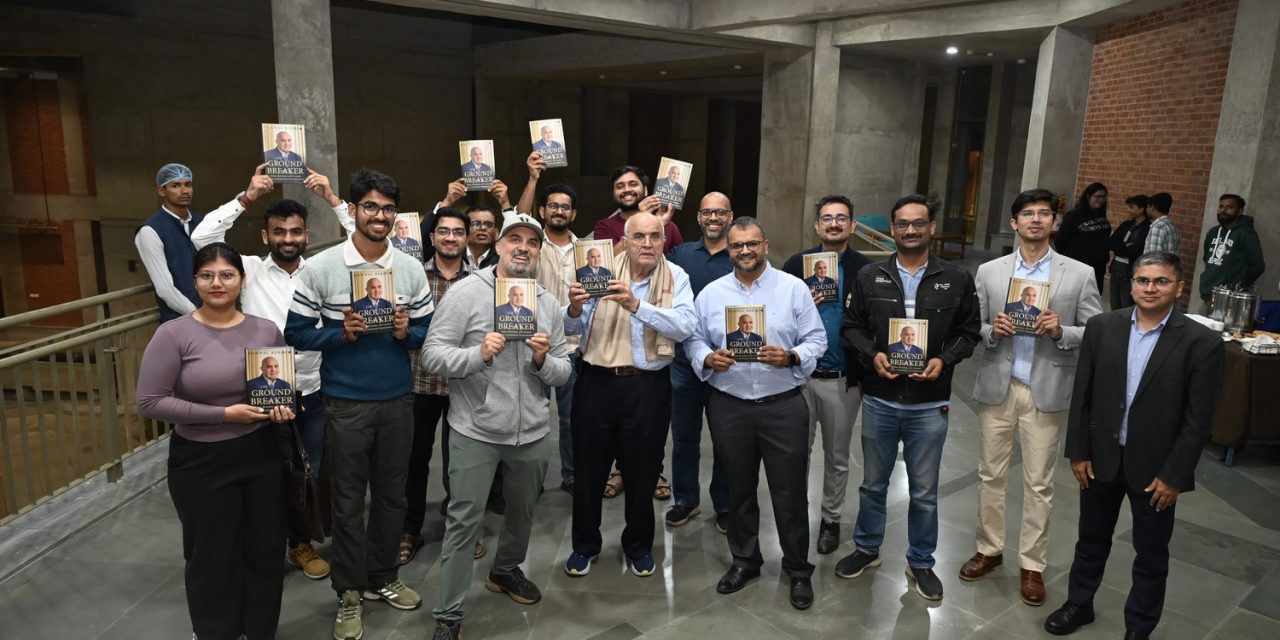
Mr Rekhi has recently documented his experiences and reflections in his memoir, The Groundbreaker: Risks, Rewards and Lessons from a Legendary Entrepreneur. The fireside chat at IITGN was a window into the stories in his book, offering a snapshot of his personal and professional journey. As Mr Rekhi noted, the path from being a quiet, shy student to a Godfather of Silicon Valley was built on the courage to ask “Why not me?” at every crossroads. By shifting the focus from individual success to collective impact, the evening’s discussion served as a reminder that the next chapter of India’s tech revolution will be written by those brave enough to bet on themselves.