
| STORY CREDITS Writer: Corena Pereira Photo: Megh Modi |
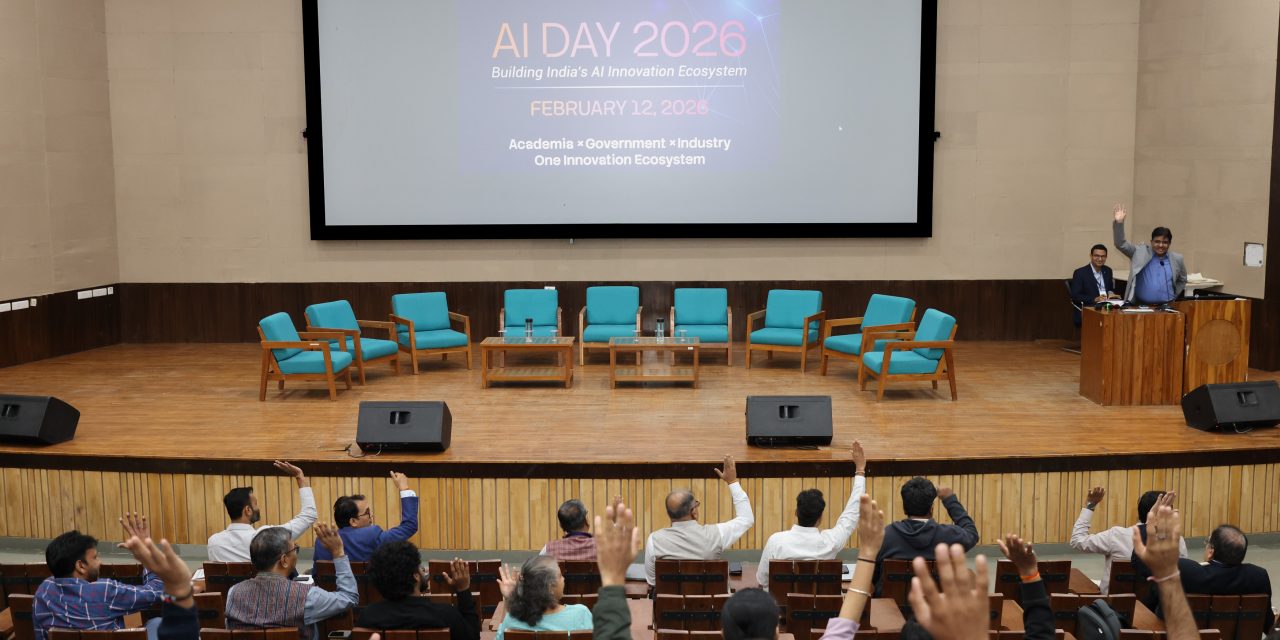
The Indian Institute of Technology Gandhinagar (IITGN) successfully hosted AI Day @ IITGN, an India AI Impact Pre-Summit 2026 event, on February 12, 2026. The event was supported by ANRF Pair, the Department of Computer Science and Engineering (CSE), and the Center for AI-driven Innovations at IIT Gandhinagar.
The day-long event convened leaders from academia, government, and industry to deliberate on the design, development, and large-scale deployment of Artificial Intelligence solutions.
Prof Vimal Mishra, Dean R&D, IITGn, addressed the gathering and emphasised the transformative impact of Artificial Intelligence, stating that AI is no longer optional but integral to everyday life. “Whatever we may feel about the pros and cons of AI, one thing is certain, we cannot neglect the impact AI is already having on our lives,” he said, highlighting how AI-driven tools are reshaping decision-making through science-backed and data-driven insights. He underscored that premier technological institutions must move beyond merely using AI tools and actively contribute to their development.
Speaking about the Centre of Excellence in AI, Prof Mishra stressed the importance of ambition and societal impact. “The bigger opportunity lies in how AI can bring social good and how it can help in sustainability, disaster management, climate resilience, healthcare, and food security,” he noted. Calling this the “era of AI,” he urged the Centre to match the rapid global pace of AI advancement and position itself as a leader in both fundamental research and real-world applications that benefit society at large.
In his opening address, Dr Mayank Singh, Coordinator, Center for AI-driven Innovations, IIT Gandhinagar, highlighted the unprecedented pace of AI advancements, noting that generative technologies are reshaping how individuals and organisations engage with technology. Referring to recent global trends, he observed that organisations worldwide are integrating AI into core workflows, with many moving towards significant automation.
Dr Singh noted that AI is no longer confined to research labs and textbooks, but has become part of everyday life through applications, automation, and generative platforms. He observed that organisations across the world are steadily integrating AI into their core functions. Emphasising the purpose of the event, he said, “AI Day is about bringing the right people together under one umbrella so that we can build meaningful and scalable AI solutions.”
He added that the initiative aims to showcase IITGN’s ongoing AI work, strengthen collaborations across academia, industry and government, and create a common platform to solve real-world problems responsibly and at scale.
He further stated that the newly announced Center for AI-driven Innovations seeks to position IITGN among leading AI hubs within a short time frame by focusing not only on research publications but also on foundational AI models, product development, startups, standards, and strong compute and storage infrastructure. Dr Singh shared that the Centre has been structured around six strategic verticals spanning foundational AI, healthcare and biomedical innovation, physical infrastructure, materials and hardware, AI and society, and strategic defence and space systems. He noted that the Centre brings together diverse faculty expertise across disciplines, enabling interdisciplinary innovation and real-world problem solving.
A key highlight of AI Day was the panel discussion on “Expectations from Academia, Government and Industry to Design, Build and Deploy AI Solutions at Scale,” moderated by Dr Anirban Dasgupta. The panel featured Dr Anasuya Bhadalkar, Joint Director (Research and Development), Gujarat State Biotechnology Mission (GSBTM); Mr Narottam Sahoo, Advisor and Member Secretary, Gujarat Council on Science and Technology (GUJCOST); Mr Chandrakant Pendor, Superintending Engineer, Gujarat Urja Vikas Nigam Limited (GUVNL); Mr Sapan Oza, Regional Head – Academic Alliance Group, Tata Consultancy Services (TCS); and Mr Satyarth Srivastava, Chairman, Gujarat Electronics and Software Industries Association (GESIA).
The speakers emphasized the importance of policy support, ethical AI practices, scalable infrastructure, skill development, and structured collaboration to build a sustainable AI ecosystem. Discussions focused on strengthening research infrastructure, ensuring balanced governance frameworks, and creating clear mechanisms for academia–industry partnerships, including clarity around funding and intellectual property. The panel agreed that India must adopt a flexible and context-driven approach to AI policy while fostering innovation through coordinated ecosystem support.
The event also featured demonstrations of six major AI Research and Development projects representing industry–academia–government partnerships.
During the second session titled The Future of AI @ IITGN, participants engaged in one-to-one discussions with vertical leads, moderated by Dr Yogesh Kumar Meena, Assistant Professor, Computer Science and Engineering, IIT Gandhinagar, followed by a panel discussion on the roadmap for the Center for AI-driven Innovations.
AI Day @ IITGN marked an important milestone in IIT Gandhinagar’s commitment to advancing AI research, interdisciplinary partnerships, and impactful innovation aligned with national priorities.